
The Florida Homeowner’s Guide to Electrical Panel Upgrades: 2026 Costs, Codes & Capacity
An electrical panel upgrade in Florida typically costs between $2,500 and $4,500 for a standard 200-amp service and takes a licensed electrician 4 to 8 hours to complete. As modern homes demand more power for high-efficiency HVACs and EV chargers, relying on an outdated 100-amp breaker box is a severe fire risk. If your lights flicker when the AC kicks on or you are constantly resetting tripped breakers, upgrading your system is the single most important safety investment you can make this year.
📌 Key Takeaways
Average Cost: Expect to invest $2,500–$4,500 for a standard 200-amp upgrade in 2026.
Critical Warning Signs: Flickering lights, warm breaker boxes, and burning smells indicate immediate danger.
Florida Climate Factors: Salt air and extreme humidity degrade electrical components twice as fast as in dry climates.
Insurance Compliance: Many Florida insurers now require panel updates (especially replacing Federal Pacific/Zinsco panels) for coverage renewal.
Never DIY: Upgrading requires utility coordination, local permits, and specialized licensing.
Table of Contents
-
What Is an Electrical Panel Upgrade?
-
10 Warning Signs You Need an Upgrade
-
Florida-Specific Risks: Why Location Matters
-
Realistic 2026 Cost Breakdown
-
The 8-Phase Installation Process
-
How to Choose a Qualified Electrician
-
Frequently Asked Questions
-
Next Steps for Florida Homeowners
What Is an Electrical Panel Upgrade?
Quick Answer: An electrical panel upgrade involves replacing your home’s central breaker box, meter base, and service wires to safely increase the total electrical capacity (amperage) your property can draw from the utility grid.
Your service panel is the central hub where utility power enters your home and is distributed to various branch circuits. Over time, physical components degrade, and technological demands outpace older infrastructure. Upgrading ensures your home meets current National Electrical Code (NEC) safety standards.
Why Amperage Capacity Matters
Understanding your current capacity is the first step in diagnosing power limitations.
-
60-Amp Service: Found in homes built before 1965. These are critically undersized for modern electronics and pose an active hazard.
-
100-Amp Service: Standard from the mid-60s to the 1990s. This capacity struggles to support modern load requirements like heat pumps or electric vehicles.
-
200-Amp Service: The 2026 gold standard. It provides the necessary “headroom” for EV chargers, pool heaters, and smart home technology without stressing the system.
💡 Expert Insight: In our extensive field experience across Florida, we find that nearly 70% of homes built before 1995 are operating at or dangerously near their maximum electrical capacity.
10 Warning Signs You Need an Electrical Panel Upgrade
Quick Answer: Key indicators that your panel is failing include frequently tripping breakers, dimming lights during appliance startup, reliance on power strips, and physical warning signs like rust, heat, or a burning odor coming from the breaker box.
Most homeowners ignore their circuit breakers until a complete failure occurs. However, your electrical system routinely provides warning signs that it is operating beyond its limit.
Performance and Capacity Symptoms
-
Frequently Tripping Breakers: Resetting a breaker weekly means your system is heavily overburdened.
-
Flickering or Dimming Lights: This indicates a severe voltage drop, usually triggered when large appliances (like your AC compressor) start up.
-
Reliance on Power Strips: Using extension cords as permanent power solutions proves you lack adequate branch circuits.
-
New Major Appliances: Adding a Level 2 EV charger (40-50 amps) immediately necessitates more capacity than vintage panels offer.
Physical and Safety Hazards
-
Warm Panel or Burning Smells: This is a critical emergency indicating active arcing or melting wire insulation.
-
Presence of a Fuse Box: Standard until the 1960s, these lack modern safety mechanisms.
-
Dangerous Legacy Brands: Federal Pacific and Zinsco panels have heavily documented failure rates where breakers refuse to trip during overloads, directly causing fires.
-
Age (30+ Years): Standard panels have a 25 to 40-year lifespan, which is often shortened by environmental factors.
-
Corrosion or Rust: Visible oxidation on the bus bars prevents reliable electrical contact and creates dangerous resistance.
-
Insurance/Inspection Flags: Florida insurers increasingly mandate electrical updates to maintain wind and fire coverage.
⚠️ Common Mistake: Never ignore a circuit breaker that feels hot to the touch. A hot breaker indicates that the internal thermal-magnetic tripping mechanism is actively failing.
Florida-Specific Risks: Why Location Matters
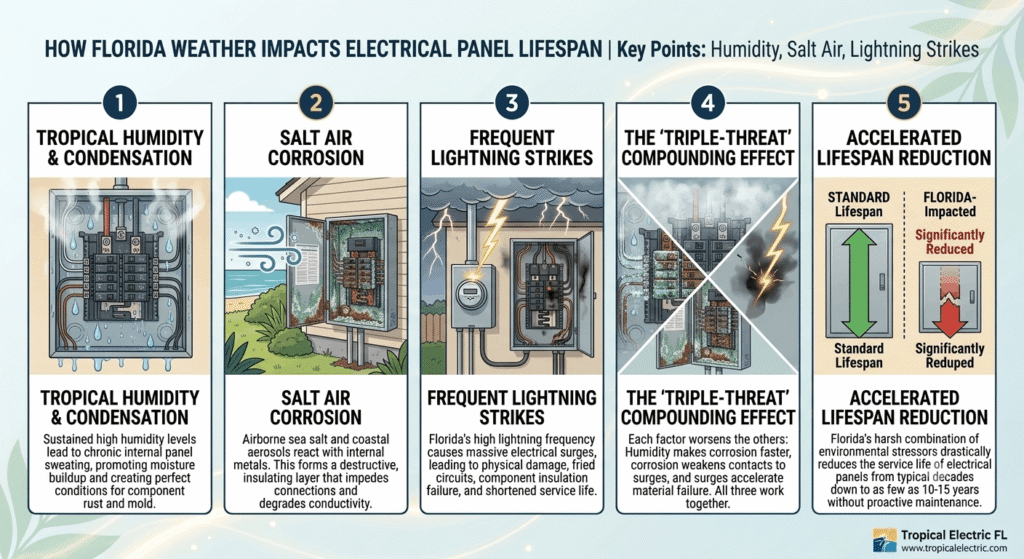
Quick Answer: Florida’s coastal salt air accelerates panel corrosion, while the state’s status as the lightning capital of the U.S. requires robust whole-home grounding systems only found in modern panel upgrades.
Florida homeowners face unique environmental stresses that transform an outdated breaker box from an inconvenience into an imminent hazard.
Humidity and Coastal Salt Air
Coastal properties from Naples to Jacksonville battle constant salt-laden air. This microscopic salt accelerates the oxidation of copper wiring and steel components. An electrical enclosure that survives 40 years in a dry midwestern climate often fails within 20 years here in Florida.
The U.S. Lightning Capital
Florida experiences more lightning strikes per square mile than any other state. Older panels lack the robust grounding systems required today. Upgrading allows for the integration of comprehensive whole-home surge protection, shielding your expensive smart appliances from catastrophic grid spikes.
Hurricane Power Resilience
If you plan to install a portable generator inlet or a permanent standby generator, your panel must safely accommodate a manual or automatic transfer switch. Outdated boxes cannot legally or safely integrate with modern backup power systems.
Realistic 2026 Cost for an Electrical Panel Upgrade
Quick Answer: A standard 200-amp panel replacement in Florida currently ranges from $2,500 to $4,500. Costs scale upward if your home requires a new meter base, structural wiring repairs, or a heavy-duty 400-amp service.
Transparency in pricing is vital for budgeting. While every residential property requires a customized load calculation, these are the realistic market ranges for 2026.
| Upgrade Type | Typical Cost Range |
| 100-amp panel replacement | $1,500 – $2,500 |
| 200-amp panel upgrade (Most Common) | $2,500 – $4,500 |
| 400-amp service upgrade | $4,500 – $8,000 |
| Upgrade + partial rewiring | $5,500 – $10,000+ |
| Subpanel addition | $700 – $2,000 |
Factors Influencing Your Final Quote
-
Service Entrance: Replacing a degraded weatherhead or exterior meter base adds $500 to $1,500.
-
Code Corrections: Mandated additions of GFCI/AFCI dual-function protection will incrementally increase hardware costs.
-
Permitting Fees: County permits typically range from $75 to $300, depending on your specific municipality.
📊 Data Point: According to the National Fire Protection Association (NFPA), electrical distribution systems are the third leading cause of home structure fires. Investing in modernization is actively protecting your property value.
The 8-Phase Installation Process
Quick Answer: Upgrading your panel requires 4 to 8 hours of power disconnection. The process involves load calculation, utility coordination, removal of the old box, installation of the new hardware, and a mandatory municipal inspection.
This is not a DIY endeavor. A professional upgrade requires tight coordination with local utility providers and municipal building departments.
-
Load Calculation: A licensed technician calculates your exact power requirements based on NEC standards.
-
Permit Application: Your contractor secures municipal permits to ensure insurance compliance.
-
Utility Coordination: The local power company (e.g., FPL, Duke Energy) is scheduled to disconnect the main drop.
-
Power Disconnect: Prepare your household for a 4 to 8-hour power outage during installation.
-
Old Hardware Removal: The old unit is safely de-energized, removed, and all branch wires are accurately labeled.
-
New Panel Installation: The new enclosure is mounted, properly grounded, and circuits are landed on high-quality modern breakers.
-
Municipal Inspection: A county inspector verifies all work meets or exceeds building codes before permanent power is restored.
-
Restoration & Testing: Power is restored, and every individual circuit is tested under live load conditions.
How to Choose a Qualified Electrician for Your Upgrade
Quick Answer: Always verify that your chosen electrical contractor holds an active license through the Florida DBPR, carries specific liability insurance, and insists on pulling the necessary municipal permits for the job.
Because high-voltage wiring directly impacts your family’s safety, vetting your contractor is paramount.
Licensing and Credentials
Verify their credentials immediately. Ensure they hold a state-issued certified or registered contractor license via the official Florida Department of Business and Professional Regulation (DBPR) portal.
Insurance and Permitting
Demand proof of general liability and workers’ compensation insurance. Furthermore, if a contractor suggests skipping the permit to “save you time and money,” terminate the consultation immediately. Unpermitted work leaves you entirely liable for future damages.
✅ Quick Tip: Ask your contractor if they handle the utility disconnect scheduling themselves. High-quality local electricians will manage the entire coordination process with FPL or Duke Energy on your behalf.
Frequently Asked Questions
Will an electrical panel upgrade lower my electric bill?
Not directly. The breaker box itself does not consume power; it only regulates distribution. However, an upgrade eliminates severe voltage drops that force appliances to work harder, and it is the necessary first step for integrating energy-saving solar arrays.
How long does a modern circuit breaker panel last?
Most residential systems are engineered to last 25 to 40 years. However, homes located directly on the Florida coast may experience a shorter lifespan—closer to 20 years—due to the aggressive corrosive effects of salt air on metallic components.
Is adding a subpanel the same as an electrical panel upgrade?
No. A subpanel simply redistributes existing power to a specific new area (like a workshop or addition) without increasing the total utility supply. A full upgrade fundamentally increases the total amperage your property can legally draw from the grid.
Do I need a 200-amp or 400-amp service?
For a standard single-family home under 3,000 square feet with gas heating, 200 amps is generally sufficient. If your property is fully electric, features dual EV chargers, or exceeds 4,000 square feet, a heavy-duty 400-amp service is likely required.
Can I upgrade my own electrical panel?
No. Panel replacement involves handling active utility feed wires that carry lethal voltage. Furthermore, Florida law mandates that a licensed electrical contractor perform this specific infrastructure change to satisfy code and insurance requirements.
Next Steps for Florida Homeowners
Your electrical infrastructure is the unseen foundation of a secure, functional home. Upgrading an outdated or overloaded system prevents dangerous voltage drops, minimizes fire risks, and provides the capacity needed for modern appliances and EV chargers. If your home exhibits any warning signs of a failing panel, acting proactively is vital.
Ready to secure your home’s power system? Follow these next steps:
-
Check your existing panel for warning signs like rust, heat, or frequent trips.
-
Identify your current service capacity (look for the main breaker number, typically 100 or 200).
-
Contact a licensed professional for a comprehensive load calculation.
Don’t wait for a critical failure to modernize your home. Contact Tropical Electric FL today to schedule your professional assessment and receive an accurate quote for your electrical panel upgrade.
Ready to upgrade? Learn about our electrical panel upgrade service in Ocala and The Villages, including 200-amp service changes and permits.